
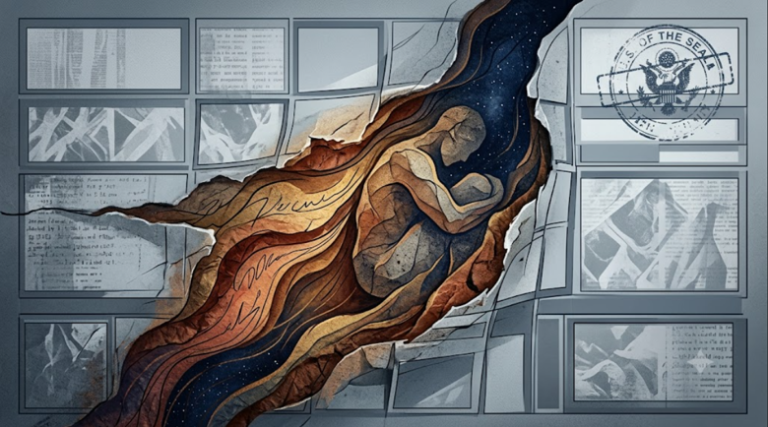
What The Form Doesn’t Ask
Yesterday I read a woman’s handwriting where I was expecting a job history. The field asked what work she’d done in the last thirty days. What she wrote instead was one line: sleeping on the streets.
That’s not what the box was for. Nothing on that form was built to hold it. She wrote it anyway, because it was true, and because somewhere underneath all the boxes was a person who needed someone to know.
I approved what I could approve. I flagged what needed flagging. I did my job, which is a smaller and more procedural thing than the moment asked for. And then I sat with it, the way you sit with a splinter you can’t quite dig out, and the thought that came up unbidden was the old church phrase: there but for the grace of God.
The Just-World Hypothesis: Why “There But for the Grace of God” Isn’t Really Humility
I’ve been turning that phrase over since. It’s supposed to be humility. Mostly, I think, it’s self-protection. Social psychologist Melvin Lerner named this back in the 1960s: the just-world hypothesis, the need to believe the world sorts people fairly, that suffering finds its way to those who somehow earned it. The alternative is unbearable: a life can come apart on nothing but bad luck and a landlord’s timeline, and there’s no invisible ledger keeping the rest of us safe.
There but for the grace of God lets me feel compassion without feeling the full floor drop out. It’s a mercy I give myself. I don’t know yet if it’s a mercy I can afford to keep giving.
Moral Injury: The Wound Nobody Trains You For
This is the part of the job nobody trains you for — not the caseload, not the software, not even the trauma histories you learn to read between the lines of an intake form. It’s what happens to you when you spend your days translating people’s worst months into categories a computer can process.
There’s a term for it in the literature: moral injury, a concept first named in military psychology and increasingly applied to social work — the injury of participating in or witnessing something that violates your own sense of what’s right, even when, especially when, you had no better option available to you. Researchers studying child welfare workers have found moral injury symptoms in this field mirroring what’s documented in combat veterans. Caseworkers carry a quieter version of it. You didn’t create the system. You’re just the human face it wears when it asks a homeless woman to document her homelessness in the third person, past tense, on a line.
This is exactly the gap I wrote about in What the Textbook Doesn’t Tell You: Trauma-Informed Care in the Real World — the distance between SAMHSA’s six principles of trauma-informed care (safety, trustworthiness, choice, collaboration, empowerment, and cultural humility) and a system that asks someone in crisis to self-certify their own suffering on a form with a word limit. It’s also the throughline in At the Crossroads: Trauma, Community, and the Quiet Heroism of Eligibility Specialists, where I tried to name the specific exhaustion of proximity — hovering at the edge of other people’s worst days, forty hours a week, without a clinical framework built to protect you from it.
Administrative Burden Is a Policy Choice, Not an Accident
It would be easy to read this as a story about one form, one field, one woman’s bad week. It isn’t. Researchers Pamela Herd and Donald Moynihan have spent years documenting what they call administrative burden — the learning costs, compliance costs, and psychological costs that stand between eligible people and the safety net they’re legally entitled to. Their research is clear on one point I think about often: these burdens aren’t accidents of bureaucracy. They’re the result of deliberate policy choices, and they fall hardest on people with the fewest resources to absorb them.
Homelessness makes this worse in a very literal way. A 2024 GAO report on homelessness and ID barriers found that people without stable housing often lack a safe place to keep the very documents — IDs, birth certificates, prior lease agreements — that benefits systems require to prove they need help. You can’t produce a paper trail for a life that paperwork was never built to survive. So instead, you get a handwritten line in the wrong field, doing its best to stand in for a filing cabinet that doesn’t exist.
What the Fiction Writer in Me Recognizes
I think this is where the fiction writer in me starts pacing. Not because I’ll ever put her words on a page — they’re hers, not mine to spend. But because I recognize the shape of what she was doing. She was doing what my characters do when the plot forces them into a room that wasn’t built for their pain: finding the one honest sentence that fits in the space they’ve been given, and writing it down anyway. I wrote about this same instinct, from the other side of the phone line, in What the Phone Doesn’t Let You See — how restraint, not spectacle, is usually the truer way to write dysregulation. That’s not a metaphor I’m imposing on her. That’s just what surviving with dignity intact looks like, in a form field or in a novel.
The Question I’m Still Sitting With
What does it cost a person to prove they’re struggling to someone who can only see them in categories? I don’t have a clean answer. I know it costs something. I know I was the one standing there when she paid it. And I know that the least I can do — as a caseworker, as a psych student, as someone who writes about people under pressure for a living — is refuse to let her sentence become just data. It was a form. It was also a small, unbearable act of honesty. Both things are true, and I’m still learning how to hold both without flinching.
Related reading (on the blog)
- At the Crossroads: Trauma, Community, and the Quiet Heroism of Eligibility Specialists — on the specific exhaustion of frontline benefits work
- What the Textbook Doesn’t Tell You: Trauma-Informed Care in the Real World — where trauma-informed theory meets an intake script
- What They Lack: Strengths-Based Thinking in a Deficit-Based System — on qualifying for help based on what you’re missing
- What the Phone Doesn’t Let You See — on reading dysregulation through a headset, and writing it into fiction
Sources & further reading
- The Just World Theory — Markkula Center for Applied Ethics, Santa Clara University. Overview of Melvin Lerner’s foundational research on why people need to believe the world is fair, and its link to victim-blaming.
- Moral Injury in Social Work: Responses, Prevention, and Advocacy — Frederic G. Reamer, Journal of Social Work (SAGE). Peer-reviewed overview of moral injury as it shows up in social work practice, including caseworker-specific findings.
- 6 Guiding Principles to a Trauma-Informed Approach — SAMHSA. The official framework of safety, trustworthiness, choice, collaboration, empowerment, and cultural humility referenced above.
- How To Address the Administrative Burdens of Accessing the Safety Net — Center for American Progress, drawing on Pamela Herd and Donald Moynihan’s research on administrative burden as a policy choice.
- Homelessness: Barriers to Obtaining ID and Assistance Provided to Help Gain Access — U.S. Government Accountability Office, 2024. Federal findings on the documentation and ID barriers homeless individuals face when applying for benefits.
 English