
Writing the fawn response honestly, from the eligibility line to the page
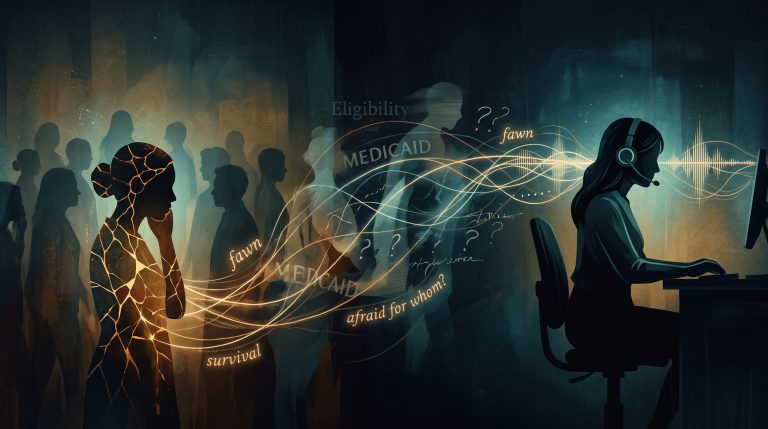
The woman on the line told me it was fine. Twice. The first time when I explained the packet needed to come back because the signature landed in the wrong box — a box nobody had told her client to skip. The second time when I said the backlog meant another two weeks before anyone could even look at the resubmission. Both times, the same bright, fast of course, I completely understand, thank you so much for explaining that — pitched a half-step too high, no pause before it arrived. The fawn response, if you know how to listen for it. I don’t sit across from clients anymore. I work the phones now, authorized representatives only — discharge planners, facility business office staff, the people hospitals and nursing homes designate to deal with Medicaid eligibility so the person in the bed doesn’t have to. But I still know that voice when I hear it. It isn’t agreement. It’s someone doing math in real time: is it safer to push back here, or to be easy.
That’s the fawn response, the fourth of Pete Walker’s four Fs, and it doesn’t stop being a fawn response just because it’s coming from a professional instead of a frightened client. The AR on my line isn’t managing her own nervous system under threat — she’s managing mine, a little, because her facility’s whole pipeline of reimbursements can hinge on staying in good standing with whoever picks up the eligibility line next time she calls. She has a caseload of thirty other people’s benefits riding on this relationship staying smooth. So when I deliver bad news, I’m not watching a survivor fawn in real time. I’m watching an institution teach a person to fawn on its behalf, one calm, grateful phone call at a time — and somewhere behind her, invisible to me now, is the actual client, whose fear doesn’t get to speak to me directly anymore. It gets laundered through a professional voice trained not to make waves.
What the Line Teaches the Manuscript
I used to think the fawn response only mattered to me as craft when I was writing the frightened party directly — the client, the survivor, the person with the most to lose in the room. The phones taught me something stranger: fawning travels. It can pass through an intermediary and come out the other side still intact, still doing its original job, just wearing a badge and a scripted greeting. Which means if I want to write an advocate character honestly — a case manager, a lawyer, a friend standing between someone and a system — I can’t let her be simply competent and unafraid. She’s absorbing somebody else’s danger and metabolizing it into professionalism, and professionalism has its own tells: the over-thanking, the refusal to ask the one clarifying question that might sound combative, the instinct to smooth a confused silence before it becomes a complaint.
That’s a different fawn than the client’s, and the difference is the craft problem worth sitting with. The client fawns to survive an encounter she can’t leave. The advocate fawns to protect her ability to keep showing up for the next client, and the next — her fear isn’t what happens to me in this exact room, it’s what happens to everyone I represent if I burn this bridge. Write them the same way and you flatten two distinct kinds of fear into one generic “nice character.” Write them differently — give the advocate a reason to be gracious that has nothing to do with the person she’s protecting and everything to do with institutional survival — and suddenly the scene has two people performing calm for two different reasons, which is so much more interesting than one.
Where the Fear Actually Lives
So when I write it now, I ask where the fawn is really coming from, because the answer changes who the scene belongs to. If my advocate character’s warmth is reaching toward the relationship she needs to preserve, it should crack exactly there — in the moment the relationship itself is threatened, not in the moment her client is hurt. A client’s fawn breaks when her physical safety does. An advocate’s fawn breaks when her usefulness does. I’d gotten that collapsed into one instinct for years, because I used to see it all happen in one room, one body, one fear at a time.
The line split it apart for me instead of simplifying it. I don’t get the client’s fear raw anymore — I get it secondhand, translated into someone else’s professional calm, and I’ve had to learn to read past the translation to find out whose nervous system is actually doing the work in any given sentence. That’s the question I bring to the page now: not is this character afraid, but afraid for whom, and on whose behalf — because a yes that’s protecting someone else is never the same shape as a yes that’s protecting yourself, even when they sound, on the surface, identically gracious.
Andi Houtsch is an Indiana Medicaid eligibility specialist and author writing at the intersection of trauma-informed care and fiction craft.
Sources Consulted
Fight, Flight, Freeze, or Fawn? — Killzone Blog
Understanding the Fawn Response to Trauma — Bay Area CBT Center
The Fawn Response — Annie Wright
Guest Post: Consent in Romance — Smart Bitches, Trashy Books
Teaching Romance and Erotica: Designing a Consent-based, Trauma-informed Online Classroom
 English