
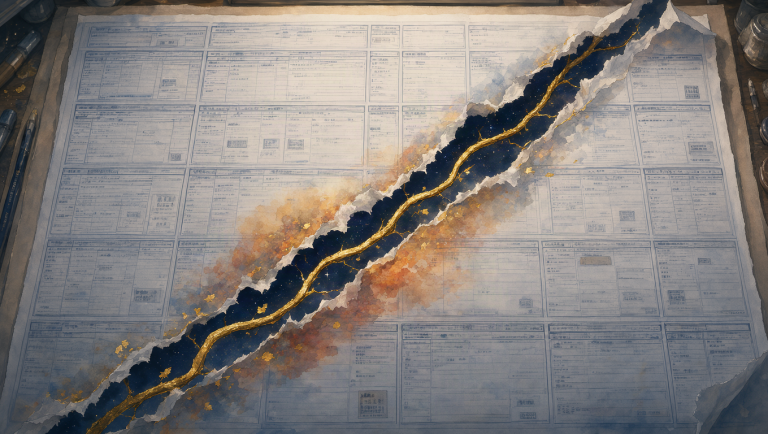
On rupture and repair in fiction — from an apology my job won’t let me finish to the reconciliation scene that gets to complete it.
A woman’s redetermination packet sat in our system for six weeks before anyone opened it — not her fault, an internal backlog, a caseworker out on leave whose cases nobody reassigned in time — and by the time it landed on my desk, her benefits had already lapsed. I had to call and tell her she’d be starting over, mid-crisis, because of six weeks that were entirely ours. She didn’t yell. She asked, very quietly, if there was anything she could have done differently. There wasn’t, and I told her so. Then I did the only thing my job actually authorizes me to do: I apologized, flagged the case for expedited processing, and read her the appeal-rights language off the screen in the very next breath, because that’s the script, because an apology that isn’t immediately followed by a disclaimer can apparently be read as an admission the agency doesn’t want on record. I have said “I’m sorry” to more people than anyone should have to, in a job that requires I say it and then immediately hollow it back out.
There’s a name for what I was reaching for and couldn’t finish — the rupture-and-repair cycle, the thing attachment researchers like Ed Tronick spent decades studying in something as small as a mother turning her face away from her infant for two minutes and then turning back. The rupture itself was never the problem in that research. Babies tolerate plenty of rupture. What predicted whether the relationship stayed secure was the repair — whether the breach got acknowledged, owned, and followed by something that actually changed. Three ingredients, not one. My job gives me exactly the first and legally discourages me from finishing the other two.
What a Reconciliation Scene Knows That I Don’t Get To
This is where the desk and the page start disagreeing. On a phone line, I get to name what broke. I almost never get to own it without a disclaimer attached, and I have no authority to promise it won’t happen again, because the backlog isn’t mine to fix. On the page, writing a reconciliation scene for two characters coming back from a real betrayal, I get to give them the whole cycle — not just the apology, but the part where the character says the exact true thing that was broken, sits in the discomfort of having caused it without immediately explaining it away, and then does something different in the very next scene that proves the apology wasn’t just words. That third beat is the one most drafts skip, mine included, back when I was writing reconciliation as a feeling instead of as a structure. Skipping it is the fictional version of my disclaimer — warmth standing in for work, a reunion that reads as resolved because two people are finally being nice to each other again, not because anything underneath actually got repaired.
I don’t let myself do that anymore, not since I started noticing how often real repair stalls at exactly the step where it would cost someone something. A character who’s sorry and changes nothing is not repaired; she’s relieved. A system that apologizes and reads you your rights in the same sentence isn’t repairing either; it’s protecting itself while sounding like it’s protecting you. Writing the full cycle on the page — rupture, honest ownership, and a cost the character actually pays to make it real — is my way of refusing to let a scene get away with what my job gets away with every day.
Where the Rupture Actually Heals
So what does it mean to keep reaching for a repair I’m structurally not allowed to finish? I’ve stopped thinking of it as failure and started thinking of it as a split. The job gets the acknowledgment — the part I’m permitted to give at volume, on a recorded line, inside a script written by people who’ve never had to deliver it. The other two ingredients, the ownership and the changed behavior, go somewhere the job doesn’t track: I flag the file in a way nobody asked me to. I check on it two weeks later when I don’t have to, when no metric rewards me for remembering a name that isn’t mine to remember. That’s not in my job description. It’s my job, and it isn’t — the system only requires the first third of a repair from me, and I keep supplying the rest on my own time because something in me refuses to call six weeks of our error “handled” just because a form got filed.
The fiction is where the other two-thirds get to exist in full, uncompressed, with nobody’s legal team asking me to hedge them. That’s not escapism from the job. It’s closer to overflow — the place the parts of repair I can’t finish at my desk still get to happen somewhere, even if it’s only on a page. I don’t pretend the two are the same transaction. The woman on the phone is still waiting on a backlog I can’t personally dissolve, and some repairs, in casework and in fiction both, don’t finish on schedule, or finish unevenly, or don’t finish at all. I’ve started letting my characters fail to fully repair things too, sometimes. It’s the only honest ending available to either of us.
Andi Houtsch is an Indiana DFR eligibility specialist and author writing at the intersection of trauma-informed care and fiction craft.
Other Posts You Might Like:
What the Job Puts Back: Vicarious Resilience in Frontline Social Work
 English