
The Repair I’m Not Allowed to Finish

On rupture and repair in fiction — from an apology my job won’t let me finish to the reconciliation scene that gets to complete it. A woman’s redetermination packet sat in our system for six weeks before anyone opened it — not her fault, an internal backlog, a caseworker out on leave whose cases nobody […]
The Fawn Response in Fiction: Writing a Yes That Isn’t
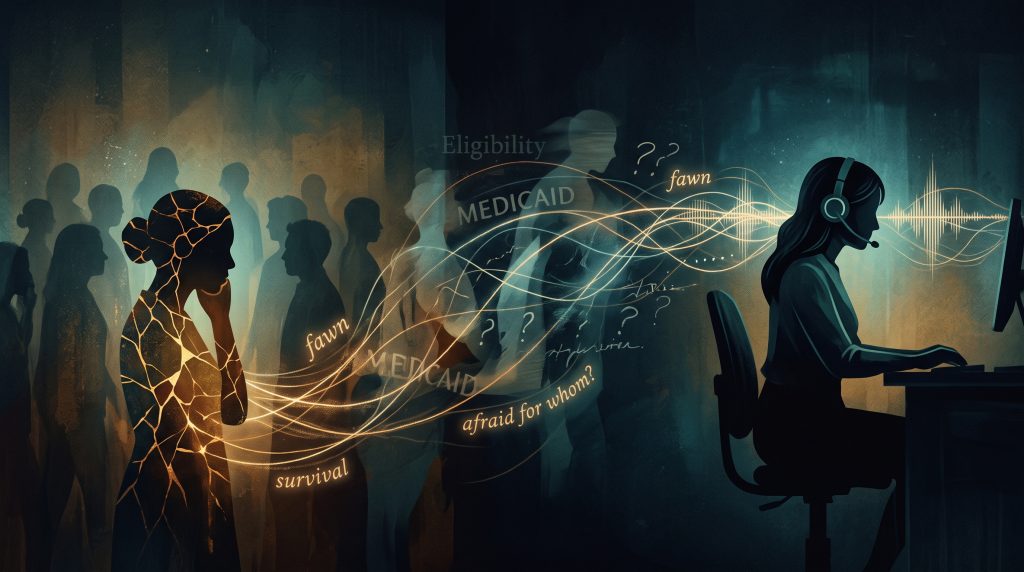
The woman on the line told me it was fine. Twice. The first time when I explained the packet needed to come back because the signature landed in the wrong box — a box nobody had told her client to skip. The second time when I said the backlog meant another two weeks before anyone could even look at the resubmission. Both times, the same bright, fast of course, I completely understand, thank you so much for explaining that — pitched a half-step too high, no pause before it arrived. The fawn response, if you know how to listen for it. I don’t sit across from clients anymore. I work the phones now, authorized representatives only — discharge planners, facility business office staff, the people hospitals and nursing homes designate to deal with Medicaid eligibility so the person in the bed doesn’t have to. But I still know that voice when I hear it. It isn’t agreement. It’s someone doing math in real time: is it safer to push back here, or to be easy.
What the Clipboard Can’t Hold: Trauma-Informed Practice at the Intake Desk

Every day, I sit across from human crisis and translate it into eligibility categories. The clipboard demands clean data—verified income limits, confirmed household compositions, calculated benefit determinations—while a messy, bleeding narrative spills out just beyond its edges. I’ve written before about the woman who told me she was sleeping outside as an aside, mid-sentence, on […]
Fifteen Minutes and a Headset

Fifteen Minutes and a Headset: Why People Fall Apart With Strangers She was doing fine until she wasn’t. That’s how it usually goes. The call opens with the recitation — the dates, the last paycheck, the hours cut, the number that has to be repeated twice because the connection is bad or because saying it […]
Writing Trauma Survivors Realistically

On trauma-informed care, administrative burden, and writing trauma survivors realistically — from behind an eligibility desk. A woman called on a Tuesday because her son’s dental coverage had closed. The appointment was in two days. Somewhere between the last review and this one, a form hadn’t been returned, a deadline had quietly passed, and a […]
What The Form Doesn’t Ask: Moral Injury, the Just-World Hypothesis, and the Cost of Proving You’re Struggling

What The Form Doesn’t Ask Yesterday I read a woman’s handwriting where I was expecting a job history. The field asked what work she’d done in the last thirty days. What she wrote instead was one line: sleeping on the streets. That’s not what the box was for. Nothing on that form was built to […]
The Voice at the Threshold On Liminality, Phone Work, and the Stories We Carry Across the Line
I never see their faces. That is the first thing people seem surprised by when I describe my work as an Eligibility Specialist in a regional change center. There is no waiting room, no desk across from mine, no eye contact over a stack of forms. There is a phone. There is a voice on […]
 English