
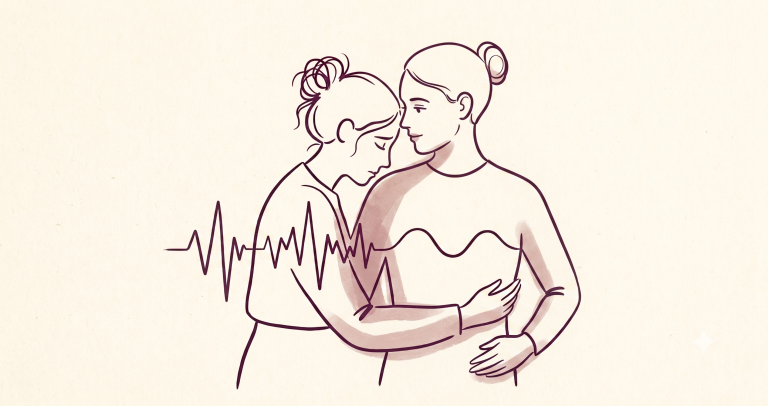
A Craft Guide to Nervous System Safety on the Page
A man is standing at my counter, and his voice has climbed an octave in the last ninety seconds. I don’t raise mine to match him. I slow down. I drop half a register. I say his name once, quietly, and wait. Somewhere around the fourth exchange, his shoulders come down an inch.
That’s co-regulation: one nervous system lending its steadiness to another until the second one can find its own footing again. It’s also, I’d argue, one of the most underused tools in a romance writer’s kit. We write chemistry constantly. We write tension, longing, the charged half-second before a kiss. We write co-regulation almost by accident, when we write it at all — because it doesn’t look like fireworks. It looks like someone’s breathing changing shape.
This is a craft guide to doing that on purpose: what co-regulation in romance actually requires on the page, the physical vocabulary it draws from, and how to build a scene where two people’s nervous systems sync instead of just their eyes meeting across a room.
What Co-Regulation Actually Is (And Why Romance Writers Miss It)
Co-regulation isn’t a mood. It’s a mechanism. One person’s calm, steady physiological state — slow breath, low voice, unhurried movement — acts as a kind of external anchor that helps another person’s activated nervous system come back down to baseline. It happens between parents and infants, between friends after a bad day, between two strangers at a DFR counter. And it happens, or should happen, constantly in romance, because romance is fundamentally a genre about two nervous systems learning to trust each other.
The mistake most of us make — I’ve made it plenty — is writing attraction and calling it intimacy. A pounding heart, a held breath, a hand that trembles when it reaches out: those are activation, not regulation. They’re the nervous system’s alarm bells, and alarm bells are great for a first-kiss scene. But a couple who spends the whole book activating each other and never regulating each other hasn’t built safety. They’ve built a very good adrenaline habit, and readers can feel the difference even when they can’t name it.
Co-regulation is the moment after the alarm bell — the moment someone’s pulse actually slows down because another person is in the room. That’s a different craft problem, and it needs a different vocabulary.
The Physical Vocabulary of Co-Regulation
If activation has a vocabulary — racing heart, heat, gasping breath, restless hands — regulation has its own, and it’s quieter. It shows up in:
- Breath. Not held breath — released breath. A character exhaling because someone else exhaled first.
- Voice. Pitch dropping, pace slowing, volume decreasing rather than rising to match distress.
- Stillness. A body that stops moving toward something and simply stays, which reads as more intimate than reaching.
- Proximity without contact. Someone sitting close enough to be felt but not touching, letting the other person choose when contact happens.
- Touch that is offered, not taken. A hand left open on the table rather than a hand that grabs.
Compare these two lines:
Her heart slammed against her ribs when he stepped closer. (activation)
She hadn’t noticed she was holding her breath until his hand settled, open, on the table between them, and she let it go. (regulation)
Both are romantic. Only the second one is doing co-regulation’s actual work: showing a body coming down, not just lighting up.
Pacing Co-Regulation on the Page
Co-regulation is as much a pacing choice as a content choice. The sentence rhythm you use should mirror the nervous system state you’re depicting, which means the craft technique here is almost entirely about restraint.
Sentence Rhythm as Nervous System Rhythm
Activation scenes tend to earn short, clipped sentences — fragments, quick cuts, a rising staccato that mimics a spiking heart rate. Co-regulation scenes need the opposite: longer, unhurried sentences that give the reader’s own nervous system somewhere to land. If you slow the prose down when a character’s body is slowing down, the reader’s body responds to the pacing before they’ve consciously registered why. This is co-regulation happening one level up — you, the writer, regulating the reader.
The Paragraph Break as a Held Breath
White space does real work here. A short paragraph, followed by a pause, followed by a single line of dialogue delivered without adornment, can function exactly like the beat of silence after someone says “I’m right here” out loud. Don’t rush to fill it with more description. The gap is the point. Readers who write also read with their bodies — let them feel the exhale before you narrate it.
Writing Co-Regulation From the Inside: POV and Interiority
The single biggest lever for writing co-regulation in romance is point of view, specifically how much physiological interiority you allow your POV character.
Skip the shortcut of naming the emotion — she felt safe with him — and instead track the body arriving at safety in real time: the throat unclenching, the jaw releasing, the count of a breath that finally goes all the way to the bottom of the lungs. This is deep POV doing what deep POV does best, but pointed specifically at the nervous system instead of at thought or feeling.
A useful test: if you can cut the word “safe” (or “calm,” or “grounded”) out of the passage entirely and the reader still understands the character is regulating, you’ve written it in the body instead of announcing it. If removing the label leaves a hole, you’ve told the reader what to feel instead of building the physiological evidence that makes them feel it.
The Difference Between Attraction and Regulation on the Page
Both belong in romance. They’re not in competition — they’re doing different jobs, and a book that only has one is missing half its emotional range.
| Attraction (activation) | Co-regulation |
|---|---|
| Heart rate rises | Heart rate settles |
| Breath catches, quickens | Breath releases, deepens |
| Body leans in, reaches | Body stills, stays |
| Reader tension increases | Reader tension resolves |
| Often external (a look, a touch) | Often internal (a body noticing itself change) |
The most effective romance scenes braid the two: activation that builds to a moment of regulation, tension that resolves into safety, want that becomes trust. If your manuscript is all activation, the relationship reads as chemistry without depth. If it’s all regulation, it can read as flat or platonic. The craft is in the sequence — earn the spike, then write the body coming down, and let the coming-down be the more intimate beat of the two.
A Scene Exercise: Building a Co-Regulation Beat
If you want to practice this deliberately, try building a single scene around this sequence:
- Establish activation. Give your POV character a nervous system that’s already elevated — from stress, fear, arousal, or all three — before the other character enters the scene.
- Introduce the regulator. Have the second character enter with a physiological state that contrasts: slower, steadier, quieter. Don’t state this — show it through their breath, voice, and pacing.
- Withhold the fix. Resist having the second character immediately touch, kiss, or verbally reassure the first. Let their steadiness sit in the scene, unclaimed, so the first character has to choose to move toward it.
- Track the shift in the body, not the label. Write the physiological change — the exhale, the loosened shoulders, the slowed pulse — without naming the emotion behind it.
- Let contact come last, and let it be small. A hand offered rather than taken. Proximity rather than embrace. Save the bigger physical beat for after regulation has already happened, so it reads as consequence rather than cause.
This sequence works whether you’re writing a quiet emotional scene or building toward something far more charged — the craft principle underneath is the same regardless of heat level: safety has to be established in the body before intensity means anything.
What Writing This Costs You
Here’s the question I keep circling back to, on both sides of my desk: is regulating someone else’s nervous system a skill you can turn off when you clock out, or does it become part of how you love people?
I don’t think I know the answer, which is probably why I keep writing toward it. What I do know is that once you’ve learned to read a body coming down — at a counter, in a session, on a page — you can’t un-know it. It changes how you write a first kiss. It changes what you notice when someone you love goes quiet. Writing co-regulation in romance well isn’t just a technique for better love scenes. It’s a way of putting on the page something most of us are doing all day without a name for it, and maybe that’s the real reason it’s worth learning to write on purpose.
If you’re working on a scene like this right now, start smaller than you think you need to. Pick one paragraph. Slow the sentences down until your character’s breath does too.
 English