
The Sound of Shame: Trauma-Informed Writing and Desire
This is an essay about trauma-informed writing and desire — about what it means to spend your days reading shame in strangers’ voices, and your nights trying to write fictional desire without shame at all. It comes from the overlap of three things I carry: frontline eligibility work, a psychology background, and a life writing […]
The Fawn Response in Fiction: Writing a Yes That Isn’t
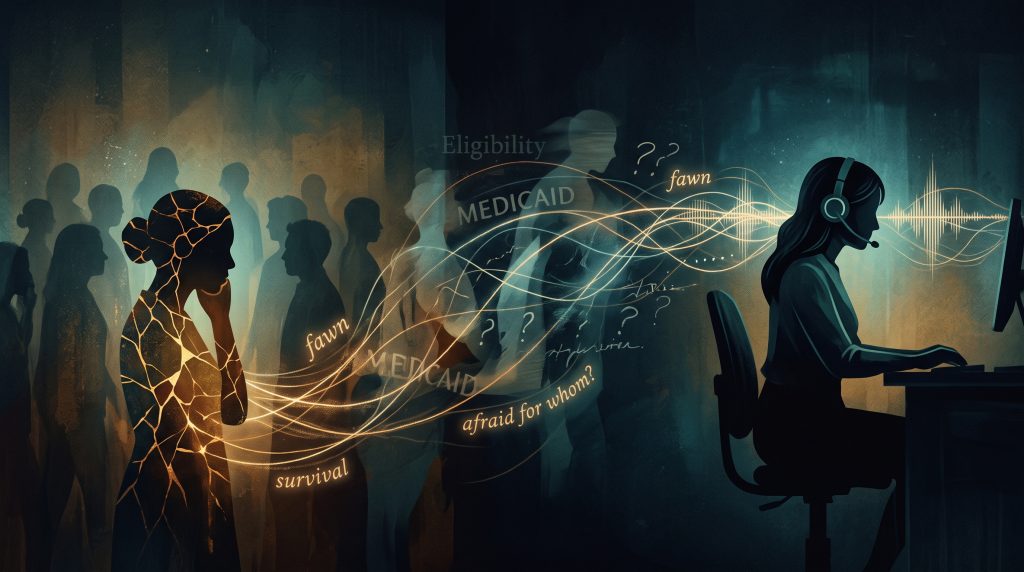
The woman on the line told me it was fine. Twice. The first time when I explained the packet needed to come back because the signature landed in the wrong box — a box nobody had told her client to skip. The second time when I said the backlog meant another two weeks before anyone could even look at the resubmission. Both times, the same bright, fast of course, I completely understand, thank you so much for explaining that — pitched a half-step too high, no pause before it arrived. The fawn response, if you know how to listen for it. I don’t sit across from clients anymore. I work the phones now, authorized representatives only — discharge planners, facility business office staff, the people hospitals and nursing homes designate to deal with Medicaid eligibility so the person in the bed doesn’t have to. But I still know that voice when I hear it. It isn’t agreement. It’s someone doing math in real time: is it safer to push back here, or to be easy.
What the Clipboard Can’t Hold: Trauma-Informed Practice at the Intake Desk

Every day, I sit across from human crisis and translate it into eligibility categories. The clipboard demands clean data—verified income limits, confirmed household compositions, calculated benefit determinations—while a messy, bleeding narrative spills out just beyond its edges. I’ve written before about the woman who told me she was sleeping outside as an aside, mid-sentence, on […]
Fifteen Minutes and a Headset

Fifteen Minutes and a Headset: Why People Fall Apart With Strangers She was doing fine until she wasn’t. That’s how it usually goes. The call opens with the recitation — the dates, the last paycheck, the hours cut, the number that has to be repeated twice because the connection is bad or because saying it […]
The Box on the Form
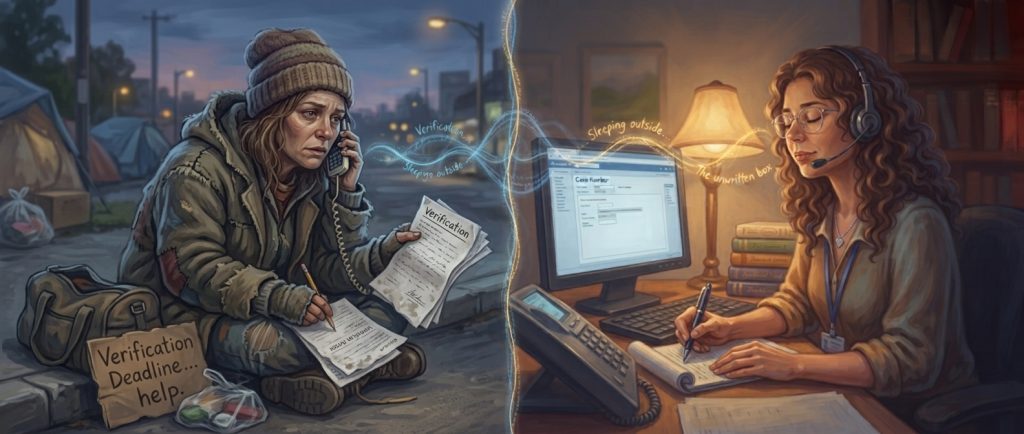
Somewhere in the middle of explaining why she couldn’t get that letter, she told me she was sleeping outside. She didn’t stop to let it land. She said it the way you’d mention a bus route, as context for why the mail was a problem, and then she went right back to asking about the verification. There is no box on the form for what she told me. That’s the part I keep turning over. People don’t lead with the real problem. They lead with the version of it that the room can receive.
5 Powerful Things I Learned About Writing a Person While Processing Someone Else’s Paperwork

I never see the people I talk to. Four years at DFR and every relationship I’ve had with a client has come through a phone line — no face, no hands, no room they’re sitting in. Just a voice, and whatever a voice decides to give me.
I had a call recently with a woman raising her four grandchildren. She’d already sent in the legal guardianship paperwork — the document that said, officially, permanently, these are mine to care for. But guardianship wasn’t enough to authorize SNAP and TANF. I needed birth certificates proving biological relationship, and she only had them for two of the four kids. And then, without my asking, her voice cracked, and she told me why: her son — their father — had died by suicide. That’s how she’d ended up with four grandchildren and a filing problem she was now expected to solve while grieving him.
4 Powerful Lessons for Writing Trauma Survivors: What a Phone Line Taught Me About the Window of Tolerance

I never see the faces. That’s the thing nobody tells you about eligibility work until you’re three months in, headset creaking against your ear, a queue of calls stacking up behind the one you’re on. I hear breath catch. I hear a hold-music silence that goes on two seconds too long. I hear a voice […]
 English