
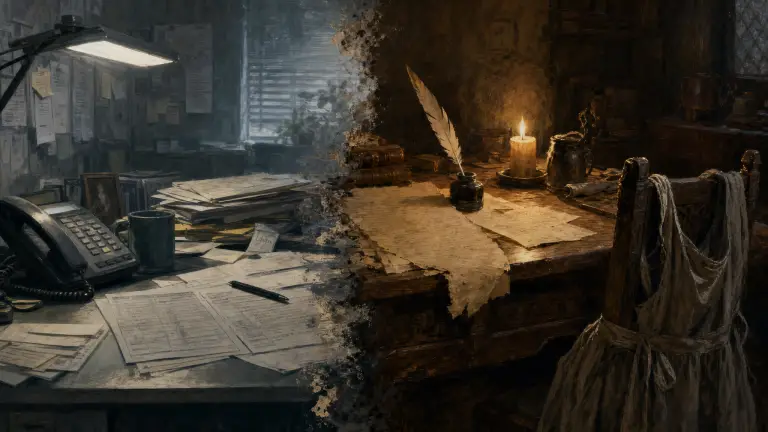
I never see the people I talk to. Four years at DFR and every relationship I’ve had with a client has come through a phone line — no face, no hands, no room they’re sitting in. Just a voice, and whatever a voice decides to give me.
I had a call recently with a woman raising her four grandchildren. She’d already sent in the legal guardianship paperwork — the document that said, officially, permanently, these are mine to care for. But guardianship wasn’t enough to authorize SNAP and TANF. I needed birth certificates proving biological relationship, and she only had them for two of the four kids. And then, without my asking, her voice cracked, and she told me why: her son — their father — had died by suicide. That’s how she’d ended up with four grandchildren and a filing problem she was now expected to solve while grieving him.
I’ve been sitting with that call all week, next to a character I’ve spent years building: Chani, a servant given to the queen by the church in my novel She Will Belong, ostensibly an honor, actually a surveillance system. Here’s what both of them taught me.
1. A category isn’t proof of a relationship — it’s an argument about what should count as one
The eligibility system wanted biological proof precisely where biology had failed her. She wasn’t just missing paperwork; she was being asked to produce evidence of the wound in order to get help for the children living inside it. Guardianship — the legal, chosen, present-tense fact of who was raising these kids — didn’t count as much as an old certificate in a drawer somewhere.
Chani had the same problem on the page. “Servant to the queen, placed there by the church” was a category, not a person. It told me her function in the plot. It told me nothing about why she’d agree to spy on a woman she might come to love, for an institution she didn’t believe in. I had the category right and the person wrong for longer than I want to admit.
2. Whatever the system can’t ask for still shows up anyway
There’s no field on an eligibility form for the reason biology failed. It didn’t matter. She told me anyway, sideways, in the middle of a sentence about paperwork. The information the system had no room for came out regardless — it just came out unrequested, unscheduled, on nobody’s timeline but hers.
Chani’s backstory works the same way in the manuscript: a family murdered by someone of a faith she came to despise through association. Nothing in her job description as “the queen’s spy” required that history. I gave it to her anyway, because a function isn’t a person, and eventually the person insists on showing up whether the plot asked for her or not.
3. Neither of them chose the role that ended up defining them
A son’s death handed a grandmother four children and a stack of impossible paperwork. A massacre handed Chani a faith to hate and a queen to watch. Neither woman picked the position she got defined by — “case number,” “servant” — and both spent their stories trying to be recognized as more than the label something else pinned on them.
4. The disclosure was offered, not extracted
I didn’t pry the suicide out of her. There’s no interview script that gets you there; I only got it because I stayed quiet long enough for her to keep talking past the required questions. Chani’s backstory isn’t dragged out of her in an interrogation scene either — it surfaces once, sideways, when the story finally gives her room to say it.
Neither reveal was mined. That’s the difference between a caseworker (or a writer) who extracts a person’s pain for the file, and one who simply leaves enough silence that it can arrive on its own.
5. The rest doesn’t disappear — it waits for someone with room to hold it
I couldn’t waive the paperwork requirement. That’s not what trauma-informed care looks like from my side of the phone — I don’t get to rewrite eligibility rules on a call. What I could do was hold four or five seconds of silence before moving her back to the checklist. That’s the only thing I own in a system that owns everything else about how the call is supposed to go.
On the page, it’s the same discipline in slower motion: not handing a character her tragic backstory in chapter one for cheap sympathy, and not withholding it forever either, letting the plot use her the way the church used Chani. The rest of a person doesn’t vanish when a system has no field for it. It waits — in a drawer of old birth certificates, in an unspoken hatred, in the pause before the next required question. Someone still has to be listening when it arrives.
If this brought something up for you
If you or someone you know is struggling or grieving a loss to suicide, you don’t have to carry it alone.
- 988 Suicide & Crisis Lifeline — call or text 988, or chat online, 24/7, free and confidential.
- AFSP: I’ve Lost Someone — the American Foundation for Suicide Prevention’s resources and Healing Conversations program for people grieving a suicide loss.
For readers doing this kind of work
- SAMHSA: 6 Guiding Principles to a Trauma-Informed Approach — the framework I keep coming back to for what trauma-informed practice actually requires, inside a system or outside one.
- Generations United: Grandfamilies — resources, policy research, and support specifically for grandparents and relatives raising kin children.
For writers wrestling with the same craft problem
- Helping Writers Become Authors: Brainstorming the Wound in Your Character’s Backstory — a solid starting framework for building backstory that shapes a character rather than just decorating her.
- Writing Trauma Without Romanticizing Pain — on keeping a character’s suffering from becoming spectacle, and centering what comes after the wound instead of just the wound itself.
 English