
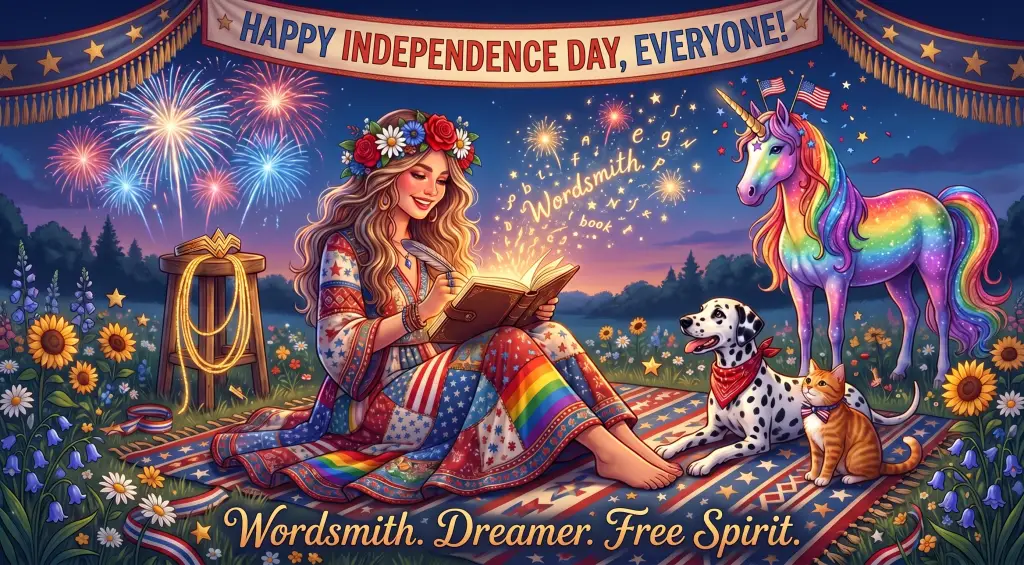
Happy Independence Day!
What Independence Day Means to Me
Every Fourth of July, while the sky erupts in bursts of red, white, and blue, I find myself sitting with something quieter than celebration — something closer to reflection. Because for me, Independence Day has never been just about fireworks and cookouts. It has always been about the deeper, more complicated, more human question underneath all the pageantry: What does it truly mean to be free?
I come to that question wearing several hats. I am an author. I am a psychology student. I am a social worker. And each of those identities brings its own lens to a holiday that this country has long held up as a symbol of liberty and justice for all — even as so many of us are still reaching for it.
As an Author
Words are my first love and my most honest tool. When I write, I am practicing a kind of independence that no government can fully grant or revoke — the freedom to tell the truth, to imagine new worlds, to give voice to people and experiences that have too often been written out of the dominant story.
Independence Day reminds me why that work matters. The Declaration of Independence was, at its core, a piece of writing. Someone sat down, chose their words carefully, and made an argument for freedom. That act — radical, imperfect, and world-changing — lives in me every time I put pen to paper. I write because silence is its own kind of oppression, and because stories have the power to liberate both the teller and the reader.
To be an author is to declare, again and again: My voice matters. This story matters. We deserve to be seen.
As a Student
Psychology has taught me that freedom is not only political — it is psychological. It is the capacity to know your own mind, to heal from what has wounded you, to choose your path rather than simply repeat the one that was handed to you.
Studying trauma and the human experience has reshaped how I see Independence Day. I think about the research on generational trauma, on the way systems of oppression imprint themselves not just on communities but on nervous systems and family lines. True independence — the kind that lasts — requires healing, not just legislation.
It requires the kind of inner work that is simultaneously deeply personal and profoundly political. Every time I learn something new about the human capacity for resilience, I become more convinced that education is liberation. Sitting in that discomfort of not yet knowing, and pushing through it anyway, is one of the most courageous acts of freedom I practice.
As a Social Worker
This is where Independence Day gets the most complicated — and the most meaningful — for me.
As an eligibility specialist, I sit across from people every single day who are navigating systems that were not designed with their freedom in mind. I see the gap between the promise of this country and its practice. I see what it looks like when someone cannot access food, or shelter, or healthcare, or safety. I see the ways that poverty, trauma, discrimination, and bureaucracy quietly steal the independence that the fireworks are supposed to celebrate.
And yet — I also see extraordinary resilience. I see people fighting for their families with everything they have. I see dignity persisting in the hardest circumstances. I see the radical act of asking for help in a culture that has too often framed need as weakness.
Social work has taught me that independence is not achieved alone. It is a communal project. The most profound freedom is not the rugged individualism of mythology — it is the kind built through connection, through safety nets, through communities that say: You do not have to carry this alone.
What It All Means
So on the Fourth of July, I celebrate. I celebrate the genuine, hard-won ideals that this country dares to aspire to, even when it falls short. I celebrate every writer who tells a truth that needs telling. Every student who refuses to stop learning. Every social worker who shows up, day after day, for people the system has tried to forget.
I celebrate the ongoing, unfinished, beautifully messy work of becoming — as individuals, as communities, as a nation — more truly free.
Because independence was never a moment frozen in 1776. It is a practice. A promise. A daily declaration.
And I intend to keep making it.
 English